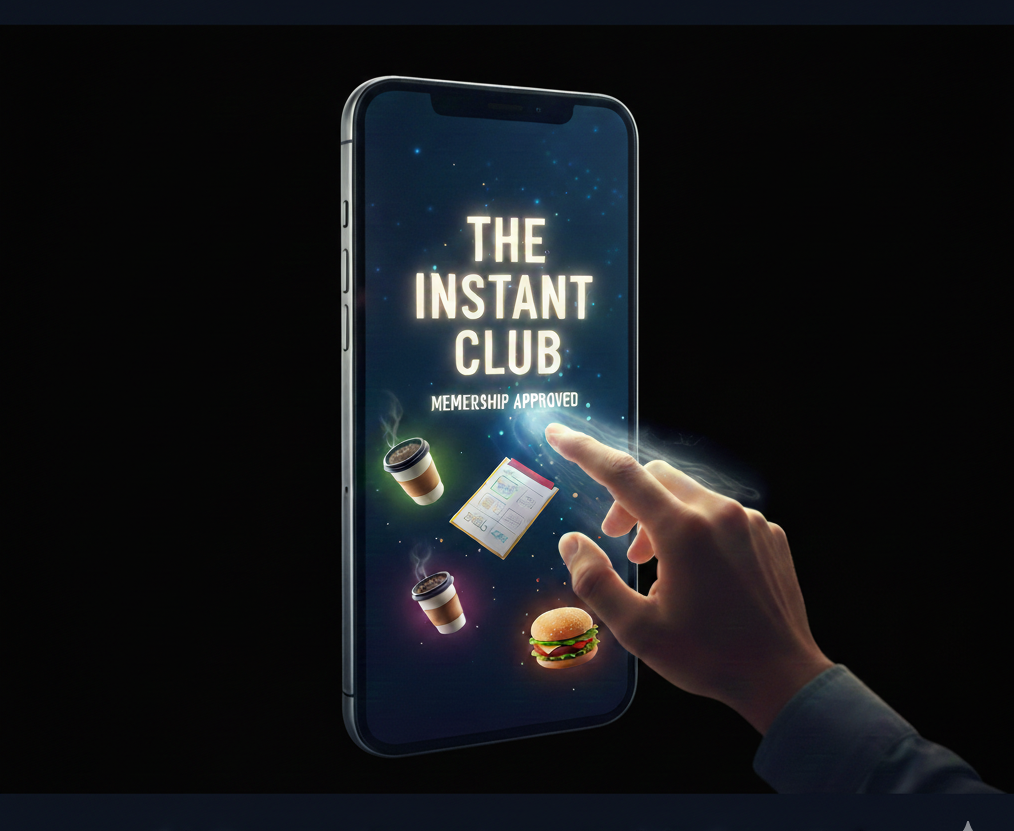
I met my neighbour just outside our building, looking very anxious. I gently asked if there was a problem. His answer shocked me. He said he was waiting for the delivery person to get the chart paper for his son, and it was almost time for the school bus to arrive. He added that my son has developed a habit of forgetting to tell us what the school has asked for, and he only remembers it in the morning. Thanks to the instant delivery service, we get the stuff!
“Instant” products were invented to save time, yet it makes you feel more rushed than ever. You are living life from moment to moment.
The Convenience Trap
We began with instant coffee to save a few minutes; we ended up with a lifestyle where everything must be immediate. While we believe we are gaining time, we are losing our Cognitive Sovereignty. This shift toward “Hyper-Convenience” has profound effects on how we function, from the biology of our brains to the character of our children.
You may not have realised that this shift toward “Hyper-Convenience”, has profound effects on how you function. Here is a breakdown of what this “instant” culture is doing to you:
The Body: Constant Low-Level Stress
Our bodies weren’t designed for the constant “ping” of digital urgency.
- The Silent Alarm: Every notification and “instant” demand triggers a micro-stress response. Over time, this keeps our cortisol levels elevated, which can lead to fatigue and poor sleep.
- The “Sedentary Speed”: Paradoxically, as our digital lives move faster, our physical lives move less. We order food, groceries, and entertainment with a thumb-swipe, leading to a more sedentary lifestyle.
- Wired and Tired: The “instant” world never sleeps. The ability to engage with work or social media at 3 AM disrupts our natural biological rhythms.
Our Life: The Depth Crisis
When everything is instant, life can start to feel “shallow”- fast-paced but lacking depth.
- Value vs. Speed: We often confuse “fast” with “good.” We choose the instant solution over the quality solution, whether it’s a ready-to-eat microwave meal or a superficial digital message over a real in-person conversation.
- Delayed Gratification: This is the “secret sauce” of human success. Studies show that the ability to wait for a reward is the key to success in many aspects of life from relationships to innovations.
The Erosion of Executive Function
Convenience is the enemy of foresight. When the “undo” button for our mistakes is a 10-minute delivery app, we stop exercising the mental muscles required to look ahead. This “Instant Recovery” lifestyle fundamentally alters our Executive Function – the set of mental skills that include working memory, flexible thinking, self-control and patience. Let us look at this in depth.
The Death of the "Mental Map" (Memory)
In the past, making an omelette required a mental inventory check before you even cracked the first eggshell. You had to hold the “state” of your fridge in your mind.
- The Shift: We no longer “store” information in our mind, we simply “outsource” it to the app. If we find we are out of eggs, we order them instantly.
- The Result: Our Working Memory weakens. If you know you can bridge any gap with a click, your brain stops prioritizing the storage of mundane but necessary details. We become “forgetful” because we have abandoned the vital act of memory retrieval.
The Erosion of Patience
The brain is highly elastic; it adapts to the environment we give it. When we get what we want immediately, we reinforce the dopamine loop. The result:
- Decreased Attention Span: We are becoming “skimmers.” If a thought or a piece of content requires deep focus, our brains—trained for the quick hit—signal boredom and urge us to switch tasks.
- Low Frustration Tolerance: When life doesn’t move at the speed of 5G, we experience disproportionate stress and irritability.
- Loss of “Experience”: We’ve become obsessed with the result (the coffee, the fit body, the promotion) and have lost the ability to find value in the process. Example: You feel like eating sponge cake – you have the option of a one-click order, but you decide to bake it. This excitement of preparing and the “forced wait” when you are baking the cake helps you not only enjoy the process but delay the gratification of eating the cake. Effectively, it not only builds excitement but helps to build your patience and enjoy the experience.
Strategic Planning vs. Reactive Firefighting
Planning is a “Time Travel” exercise: “If I want X tomorrow, I must do Y today.” In an instant world, this bridge is burned.
- The Planning Paradox: When we can solve a problem instantly, we stop planning and start reacting.
- The Loss of “Chain Reactions”: We lose the ability to see how today’s neglect creates tomorrow’s crisis. We begin to live in a permanent, reactive “Now,” which makes long-term projects like a thesis or a career path -feel insurmountable later in life because we’ve lost the “Breadth of Time.” This affects our behaviour and decision-making abilities.
The Impact on the Child: The "Safety Net" Trap
Consider the common modern dilemma: A child realizes they need craft paper for school just 30 minutes before the school bus arrives. If the parent instantly orders it via an app to “save the day,” a critical learning opportunity is lost.
- Responsibility Erosion: Responsibility is built through the “sting” of a mistake. If a child faces the social discomfort of explaining a missing item to a teacher, their brain records that discomfort. This “sting” is the biological fuel for future planning.
- The Loss of Resourcefulness: When solutions are digital transactions, children never learn to “make do,” substitute materials, or negotiate with a friend. They learn that the solution to every problem is a transaction, not a thought process.
The Final Insight
Just because we can have it now doesn’t mean we should. There is a certain “mental virtue” that only grows when we are forced to wait. That “mental virtue” is patience, it helps in regulating emotion. Patience behaves exactly like a muscle: it only grows under resistance, or you may term it as forced waiting.
Here is why this virtue is unique:
- It transforms frustration into stillness:It builds the ability to hold a desire without immediately acting on it.
- It reduces anxiety:It helps you accept the “gap” between wanting something and getting it, making you less reactive to uncertainty.
- It boosts self-control:It strengthens your ability to bypass instant gratification in favour of long-term rewards. You move from being a passive consumer to being the architect of your life.
- Friction over Convenience: By choosing friction over convenience, you are not making your life harder, but effectively, you are making your brain sturdier.
- Reclaiming Planning: This boosts your memory and helps you to improve your cognitive function strengthening planning and strategizing. It builds resilience and teaches that actions have consequences.
We are “biologically misaligned with the instant culture. Our nervous systems are reacting to a delivery notification with the same chemical spike our ancestors used to escape predators. We are using “survival energy” to track a package even if insignificant.
Convenience is a tool, but friction is a teacher. Every time you choose the ‘slow way’- the hand-ground coffee, the walk to the store, or the difficult conversation instead of the text, you are performing a quiet act of rebellion. In this way, you are reclaiming your cognitive sovereignty.
Stop being a slave to the ‘instant’ and start becoming the architect of your life.