
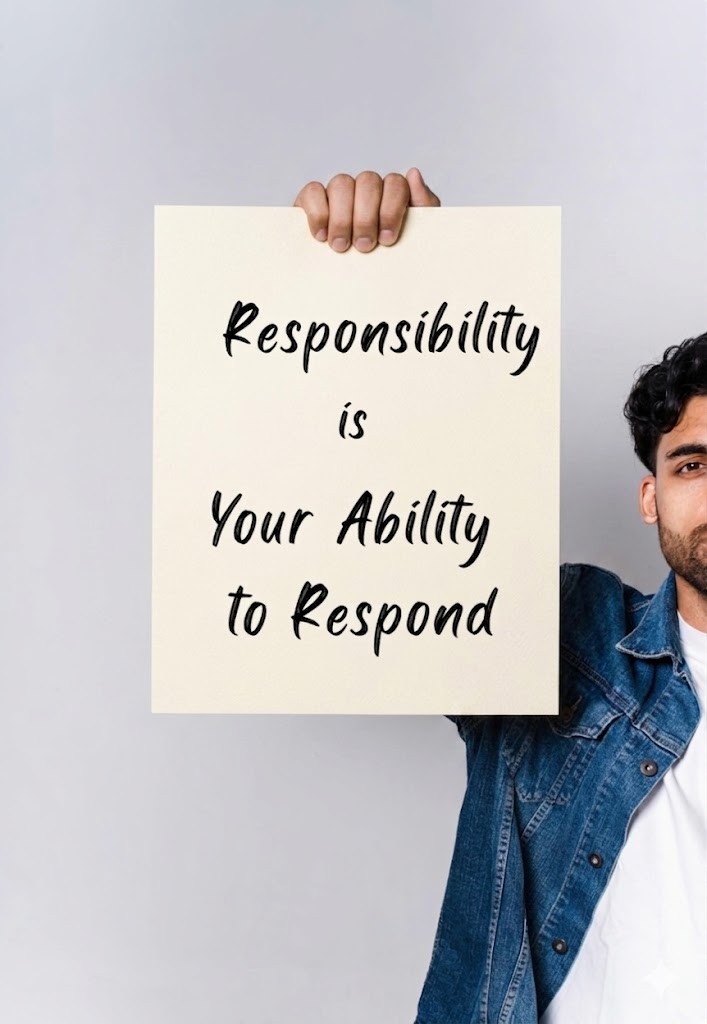
We often treat the word responsibility like a heavy winter jacket – something we are forced to wear in a cold place. It limits our movement and makes us uncomfortable, leaving us with no option. We associate it with paying bills, meeting deadlines, and keeping the household or the office running.
But if you analyse the word “Responsibility,” you will find something far more liberating. Effectively, it is Response-Ability.
Responsibility is quite literally your ability to respond. This shift in perspective changes everything. It takes you out of the passenger seat of Reaction and puts you firmly behind the steering wheel of Action.
To switch from the passenger seat to the steering wheel, you have to change how you talk to yourself when things get heavy. Instead of treating your to-do list like a series of external demands with thoughts like “I have to finish this” or “I should be doing more,” gently flip the script to ownership: “I am choosing to handle this right now.”
It sounds incredibly simple but shifting from “have to” to “choose to” immediately strips away the feeling of being forced or overwhelmed. You aren’t waiting for a perfect burst of motivation to strike, nor are you scolding yourself for sitting still. You are just acknowledging that you have the wheel, you have options, and you can decide to take one tiny step forward simply because you said so.
Uncovering Your Hidden Capacity
Finding that internal ability often has less to do with a sudden burst of energy and more to do with shifting how you measure your own readiness. When the road ahead looks daunting, here are five practical ways to uncover the capacity you already have:
- Audit Your Past “Wins”: When self-doubt whispers that you can’t handle something, look backward instead of forward. Remind yourself of a time you faced a completely unfamiliar situation, felt out of your depth, and figured it out anyway. Your track record of navigating uncertainty is proof of your underlying ability.
- Lower the Bar for Entry: We often mistake a lack of ability for a lack of perfection. If you feel you don’t have the capacity to finish the whole project, write the entire chapter, or solve the big problem today, check if you have the ability to just do the first fifteen minutes. Action builds competence, which in turn builds confidence.
- Shift from “Can I?” to “How Can I?”: Asking “Can I do this?” invites a binary yes-or-no answer that often defaults to “no” when we are tired or overwhelmed. Flipping it to “How can I make this manageable?” changes your brain’s role from a harsh judge to a creative problem-solver.
- Borrow Resources Safely: True ability includes knowing when to lean on external resources. Whether it’s seeking a mentor’s perspective, using a structured framework, or breaking a goal down into a micro-checklist, you don’t have to generate every ounce of capability strictly from your own reserves.
- Learn to Delegate: Learning to delegate is the ultimate test of response-ability because it requires a massive identity shift. For high achievers, self-talk is usually hardwired to believe that doing it all is the definition of capability. True responsibility isn’t about physically doing every task yourself; it’s about ensuring the right outcome happens. When you hold onto everything, you become the bottleneck, restricting your team’s growth and burning out your own capacity.
Ability isn’t a fixed reservoir you either have, or you don’t; it’s a flexible resource that expands the moment you stop analysing the horizon and just focus on the immediate next move.
The Home Front: Live Beyond the To-Do List
At home, we often mistake responsibility for a checklist. But true response-ability is about the energy you bring to the people you love, moving past rigid, traditional roles.
- Navigating the “Provider” Trap
True response-ability means looking past the purely functional role of keeping the household running and understanding its silent needs. It’s the ability to respond to a partner’s exhaustion not with a passive “What’s for dinner?” but with a collaborative “Let’s prepare dinner together.” It is responding to a child’s curiosity with genuine presence rather than a distracted nod while looking at a screen.
- Balancing the “Mental Load”
For whoever carries the invisible, cognitive burden of managing everyone’s needs, response-ability is the courage to respond to your own needs first. You cannot pour from an empty cup. True ability to respond means setting healthy boundaries and releasing the guilt of not being everything to everyone, all the time.
The Professional Arena: Ownership Over Obligation
In the workplace, your ability to respond is your greatest professional asset. It is what separates a baseline manager from a true leader.
- Leading with EQ
By taking conscious responsibility at work, you evolve. It’s no longer just about hitting targets; it’s the ability to respond to interpersonal dynamics with emotional intelligence (EQ). It’s responding to a team’s failure with mentorship and curiosity instead of an ego-driven blame game.
- Navigating the Leadership Double-Bind
Modern professionals face intense pressure to be both soft and strong, empathetic yet decisive. Response-ability is knowing when a situation requires the strength of a boundary or the softness of empathy – and choosing that response intentionally, rather than reacting out of stress. It gives you the power to ensure your voice is heard and your boundaries are respected without losing your authentic self.
The P.A.U.S.E. Method
To move from reacting to responding, you need a bridge. When you feel a trigger rising, use this framework to manage your ego and reclaim your power:
- Perceive: Notice the trigger. Feel the rising heat in your brain or the urge to snap and catch the reaction before it leaves your mouth.
- Assess: Ask yourself honestly: “Is my ego driving this right now, or is it my true purpose?”
- Understand: Dig for the root cause. Identify what is actually happening. Is the tight deadline the real problem, or is it an underlying fear of failure?
- Select: Choose the response that aligns with your core values. This step is where your ultimate power and freedom live.
- Execute: Commit to the choice you just made and step forward with clarity and action.
The Ripple Effect
When you choose your responses, you create a ripple effect. Just as a single act of kindness can change someone’s day, a single conscious response can save a relationship or turn around a failing project.
Responsibility isn’t a weight you carry; it’s a muscle you flex. The more you use your ability to respond, the more freedom and inner strength you will find.